
Introduction
Have you ever finished a sweeping fantasy series and felt ready for something darker? Something that feels closer to our world but twisted just enough to make you think?

You are not alone. Many readers find themselves at this exact crossroads. They want to move from magical kingdoms into worlds that reflect real fears about society, technology, and survival.
But here is the overwhelm moment. When you search for a next read, you get hit with huge lists. Goodreads alone shows thousands of titles in dystopian and post apocalyptic sci fi books. Where do you start? You have heard of classics like 1984 and The Giver. You might already know the ready player one book or some lois lowry books. But finding the one story that bridges the gap between fantasy and gritty sci-fi can feel impossible.
That is where the running man book comes in. Written by Stephen King writing as Richard Bachman, this fast paced novel gives you a brutal reality show set in a collapsing world. It feels familiar enough for fantasy fans who love high stakes but introduces the cold logic of dystopian systems. And bonus: you can find a 1984 audiobook free in many library apps to pair with your reading.
In this guide, I promise a curated reading list that cuts through the noise. No more scrolling through endless suggestions. The best dystopian books to read in 2026 are right here, starting with the perfect gateway title.
Looking Beyond Fantasy? The Ridiculous offers imaginative worlds with a comic sci-fi twist.
Why Dystopian Fiction Is a Natural Fit for Fantasy Fans
If you love fantasy, you already know what it feels like to step into a fully built world. You know the thrill of learning a new magic system or the weight of a prophecy. Here is the thing: dystopian fiction gives you that same hit. The only difference is the setting feels a little closer to home.
Think about the best fantasy series you have read. They all share three things: careful world building, big moral questions, and characters who fight against impossible odds.
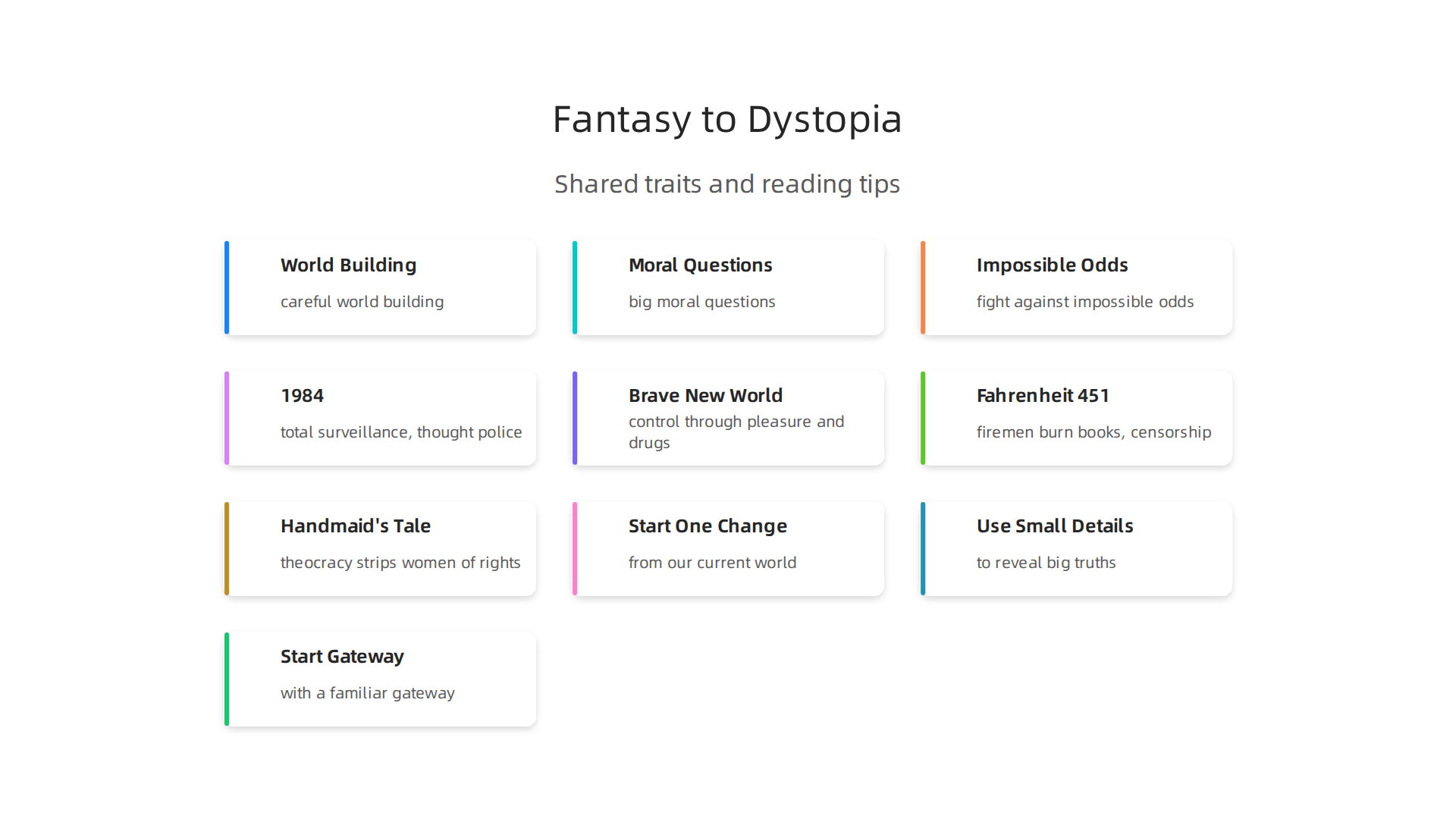
Dystopian stories offer every single one of these. Instead of dragons or elves, you get surveillance states, crumbling economies, and desperate survivors. The stakes are just as high.
Look at the running man book. Stephen King, writing as Richard Bachman, drops you into a United States that has fallen apart. The year is 2025. The economy is ruined. Violence is everywhere. And the main character, Ben Richards, signs up for a deadly game show just to feed his family. That is not so different from a fantasy hero who accepts a dangerous quest to save their village. The Wikipedia entry for The Running Man describes it as a dystopian novel set in a nation in ruins. Sound familiar? It should.
Another thing fantasy fans love is rebellion. Frodo fights Sauron. Katniss fights the Capitol. In dystopian fiction, rebellion is often baked right into the plot. Whether it is the resistance in 1984 or the quiet defiance in The Giver, you get that same pulse of hope against tyranny. If you enjoyed lois lowry books like The Giver, you already know how a controlled society can feel both strange and real. The same goes for the ready player one book, which throws you into a world where reality is so bad that people escape into a virtual one.
Dystopian fiction also satisfies your curiosity for "what if" scenarios. Fantasy asks what if magic existed. Dystopian asks what if governments got too powerful. What if the climate collapsed? What if technology took over? That speculative spark is the same. It makes you think about your own world in a new way.
If you are ready to step beyond fantasy and try something that feels like our world but twisted darker, dystopian books are the perfect next step.
Looking Beyond Fantasy? The Ridiculous offers imaginative worlds with a comic sci-fi twist.
The Running Man: Stephen King’s Dystopian Masterpiece Revisited
Here is a strange thing about the running man book. Stephen King, writing under the pen name Richard Bachman, set his story in the year 2025. That was last year. And while we are not living in a total collapse, some parts of the novel feel uncomfortably close to reality.
The book drops you into a United States where the economy has crumbled and violence is everywhere. The Wikipedia entry for The Running Man describes it plainly: "the nation’s economy is in ruins and world violence is rising." Sound familiar? It should. We have seen rising inequality, media that treats tragedy like entertainment, and a growing sense that the system is rigged. King saw it coming decades ago.
What makes the novel so powerful in 2026? The themes of media manipulation and inequality are more alive than ever. The story follows Ben Richards, a desperate man who signs up for a deadly game show called The Running Man. The whole country watches him run for his life. Viewers vote on what traps to throw at him. It is reality TV at its most savage. One critic called the book a perfect example of a "persistently resonant dystopia," which is exactly right. You can read a deeper look at that idea here.
If you have only seen the 1987 movie with Arnold Schwarzenegger, you are in for a surprise. The film is fun and over the top. The book is grim and relentless. The protagonist is not a tough action hero. He is a broken man. A reviewer at The Battalion noted that Richards was "pitiful from start to finish," which is true but not a criticism. That is the point. He is a regular guy pushed to the edge. That makes the story hit harder.
Why does this matter for a fantasy reader? Because great dystopian fiction, like great fantasy, forces you to ask hard questions. What would you do to save your family? How far would you let the government go? The world may look different from Middle-earth or Hogwarts, but the emotional weight is the same.

If you finish The Running Man and want something a little lighter but still strange and creative, try a sci-fi comedy detour. It is a ridiculous series that keeps the weird worlds but adds wit.
Want to see where this novel ranks among King’s best? Check out our guide to the Stephen King novels ranked from a fantasy reader’s view.
Classic Dystopian Novels That Defined the Genre
If The Running Man got you hooked on grim futures, you are not alone. That book stands on the shoulders of some true giants. The classics of dystopian fiction built the whole playground for authors like Stephen King. And in 2026, these older novels still feel like they were written yesterday.
Let me walk you through the heavy hitters. These are the books that shaped how we think about control, resistance, and what it means to be human.
1984 by George Orwell
You have probably heard of Big Brother. This novel introduced the idea of total surveillance, thought police, and constant rewriting of history. It is one of the most referenced books ever. In fact, a list from Goodreads ranks 1984 as the second best dystopian novel of all time, just behind The Hunger Games. If you have never read it, you can find the 1984 audiobook free on many library apps. It is a fast way to get the full weight of Orwell’s warning. For fantasy fans, this book shows how worldbuilding can create a system that feels both alien and terrifyingly real.
Brave New World by Aldous Huxley
Huxley took a different approach. Instead of fear and brutality, control comes through pleasure and drugs. People are genetically engineered and conditioned to love their servitude. Some argue this book is more relevant now than 1984 because we drown in distractions. It is a classic example of a society that seems happy on the surface but is hollow inside. If you enjoy stories where the world feels off-kilter, this one is essential.
Fahrenheit 451 by Ray Bradbury
Bradbury imagined a world where firemen burn books. The government wants everyone to be happy and not think too much. The hero, Montag, starts to question everything. This book is short but powerful. It warns about censorship and the loss of critical thinking. The Glossary magazine article on best dystopian books says that fiction has never felt more like the news, and this book proves it.
The Handmaid’s Tale by Margaret Atwood
Atwood’s masterpiece shows a theocracy that strips women of all rights. It draws on real historical practices and feels disturbingly possible. Many readers put it on their must-read lists. The Boston Public Library list includes it as one of the top dystopian novels for current times. For fantasy readers, the worldbuilding is top notch, and the slow resistance story will keep you turning pages.
The Giver by Lois Lowry
You might know this from school. Lois Lowry books often explore tough themes, and The Giver is her most famous. It presents a community that has erased pain, war, and strong emotions. But when twelve-year-old Jonas gets the memories of the past, he realizes the price of peace. A reviewer at Books of Brilliance calls it one of the best dystopian novels ever written. It is a great entry point for younger readers or anyone who wants a quieter, more emotional story.
Why Fantasy Fans Should Care
You might think dystopian fiction is different from fantasy. But both genres build worlds with their own rules. Both ask moral questions. Both put ordinary people in extreme situations. The Pan Macmillan list of 30 best dystopian novels includes titles that blend dystopia with science fiction and fantasy elements. Reading these classics will sharpen your ability to see how a world works, and that makes you a better fantasy reader too.
If you want to explore more about how authors build these worlds, check out our guide for fantasy readers on George Orwell and other authors. It connects the dots between dystopia and fantasy.
Want Something a Little Lighter?
After all that doom and gloom, you might need a break. Try The Ridiculous, a comic sci-fi series that keeps the wild worlds but adds laughs. It is a perfect palate cleanser between heavy reads.
Modern Sci-Fi: From Dystopia to Hopeful Futures
So after all those classic dystopias, you might be wondering: is every future totally doomed?
Here’s the good news. Not anymore.
Modern science fiction has shifted things in a big way. Yes, you still get dark worlds and tough situations. But authors today are blending that tension with real hope. They write futures worth fighting for. And in 2026, this mix is exactly what many readers crave.

The Rise of Hopeful Sci-Fi
Think of it this way. The the running man book showed a world with no way out. But newer stories give you characters who not only survive but rebuild. They fix broken systems. They create communities. That shift matters.
Take the Hugo Award for Best Novel winners as a guide. The Hugo Awards have honored science fiction and fantasy since 1953, and the Wikipedia page for the Hugo Award for Best Novel shows how the genre has evolved. Recent winners lean into big ideas about connection, justice, and healing.
Authors Changing the Game
Three names stand out right now.
N.K. Jemisin broke records by winning three Hugos in a row for her Broken Earth trilogy. Her worlds are harsh. But her characters find hope in the rubble. She proves that post apocalyptic sci fi books can still feel uplifting. Her work is a masterclass in building a broken world and then showing how people fix it. If you love detailed worldbuilding, she is your author.
Ann Leckie changed how we think about identity with her Imperial Radch series. She plays with pronouns and perspective in ways that feel fresh and natural. A reviewer on the Nebula Awards page notes that her work explores what it means to be human in a universe full of artificial intelligence and alien cultures. It is thoughtful, smart, and never preachy.
Becky Chambers might be the most hopeful voice in sci-fi right now. Her Wayfarers series focuses on found family, kindness, and cooperation. There is no big war. No evil empire. Just people trying to get along in space. It sounds simple, but it is deeply satisfying. If the running man book left you breathless, Chambers will give you a warm cup of tea.
How This Helps Fantasy Readers
Here is the connection. Fantasy readers already love worlds with their own rules, their own politics, and their own magic systems. Modern sci-fi does the same thing but with spaceships and AIs instead of dragons and spells.
Reading across genres makes you a better reader. You see new ways to build tension, new ways to develop characters, and new ways to imagine hope. The Abebooks guide to Hugo Awards shows that many recent winners blur the line between fantasy and sci-fi anyway. The two genres are cousins, not strangers.
For example, Ready Player One book fans will love the puzzle-solving energy in some of these modern titles. And if you are a fan of lois lowry books, you will appreciate how these authors handle big emotional themes without talking down to you.
If you want to explore more diverse voices in the genre, check out our list of diverse fantasy series by women that will captivate you. It connects directly to the kind of storytelling Jemisin and Chambers do so well.
Want a Fun Break from All the Heavy Stuff?
Sometimes you need a story that takes itself less seriously. If you want a break from deep themes and complex worlds, try a series that keeps the sci-fi setting but adds sharp wit and ridiculous situations. It is the perfect way to refresh your reading mood.
Key Elements of Great Dystopian and Sci-Fi Storytelling
Now that you have seen how modern sci-fi leans into hope, let us break down what actually makes these stories work. Whether you are reading the running man book or a hopeful space opera, the same core elements keep you turning pages.
World-Building: Making the Future Feel Real
The best dystopian and sci-fi stories do not just tell you the world is broken. They show you how it got that way.
According to a guide on crafting dystopian settings, the best authors start with something familiar and then twist it. They build their worlds using descriptive words that speak to all senses. You feel the grit, smell the smog, and hear the propaganda announcements.
A strong world has rules that make sense. In the running man book, the game show is rigged, but the rules are clear. That clarity makes the tension unbearable. The Worldbuilding in the Dystopian World guide explains that dystopian stories expose darkness like injustice, poverty, and oppression. But they do it through a world that feels logically built.
Some tips for great world-building:
- Start with one change from our current world
- Show how that change affects daily life
- Let the setting feel like a character on its own
- Use small details to reveal big truths
For more on this craft, check out tips on writing unforgettable dystopian fiction which covers how to avoid common pitfalls.
Character Archetypes: The Rebel, The Everyman, The Victim
Here is the thing. A cool world means nothing without someone to care about.
Great dystopian and sci-fi stories use character archetypes that feel familiar yet fresh.
The Rebel fights the system. Think of Winston Smith in 1984 or the protagonist in the running man book. They know the truth and cannot stay quiet. They give readers someone to root for.
The Everyman represents us. This character is not special. They have no superpowers or secret training. They are just trying to live their life when the world falls apart. Many post apocalyptic sci fi books use this archetype to show ordinary courage.
The Victim suffers under the system but rarely fights back. This character shows the real cost of a broken society. Their story can be the most heartbreaking and the most powerful.
A guide on balancing world-building with character development points out that you need to begin with something familiar and then let the story unfold through a character who feels real. That is the secret. The world matters, but the character matters more.
If you love deep character work, you will enjoy our reading guide to the Percy Jackson books. While not dystopian, Rick Riordan uses the same archetype structure to pull readers in.
Thematic Depth: Ethics, Technology, and Society
Here is where dystopian and sci-fi fiction separates itself from pure entertainment.
The best stories ask hard questions.
What happens when technology outruns our ethics? How do we keep our humanity in a system that treats us like numbers? Who gets to decide what is normal?
The Writer’s Digest guide to near-future dystopian novels suggests starting with a real-world issue and pushing it just a few steps forward. That is how you get stories that feel both fresh and urgent.
1984 asked about surveillance and truth. The Running Man asked about entertainment and exploitation. Ready Player One book asks about escapism and connection. Each of these books uses its world to explore an idea that matters today.
And yes, if you are looking for a way to revisit that classic, you can find an 1984 audiobook free version online to hear Orwell’s warnings in a new format.
For readers who want to explore how authors handle these big themes, our guide to George Orwell and other literary giants connects the dots between classic dystopian ideas and modern fantasy.
Bringing It All Together
The authors who write unforgettable dystopian and sci-fi stories know how to balance all three elements. They build worlds that feel real. They create characters you care about. And they ask questions that stick with you long after you close the book.
Whether you are diving into the running man book or exploring modern hopeful sci-fi, look for these elements. They are the reason some stories stay with you forever.
Looking for Something Completely Different?
Sometimes you need a break from heavy themes. If you want a story that uses sci-fi world-building but keeps things light and funny, try a playful detour into ridiculous territory. It is the perfect palate cleanser.
How to Build Your Perfect Reading List
Okay, so you want to dive into dystopian and sci-fi stories. But where do you even start? There are so many options, it can feel a little overwhelming.
Here is a simple strategy that works every time.
Start with a familiar gateway. For many readers, that is the running man book. You probably know the movie. The book is darker, faster, and sharper. It is a perfect entry point because the plot is simple, the stakes are life or death, and Stephen King’s writing moves at a breakneck pace.
You can find it easily at major retailers like Barnes & Noble alongside other dystopian classics like Fahrenheit 451 and Dune. And if you want to browse multiple stores, our guide to the best platforms for fantasy books can help you pick a spot to start shopping.
Next, explore the classics that shaped the genre. Once you finish the running man book, you will see its DNA in everything that came after and before.
Pick up 1984 by George Orwell. If you prefer listening, look for an 1984 audiobook free trial to hear the story in a whole new way. Lois Lowry books like The Giver are also perfect for this stage. They are shorter, but they pack a huge emotional punch.
The NPR Top 100 Science Fiction and Fantasy Books list is a great place to find these foundational reads. For a deeper dive into Orwell’s world, check out our fantasy readers guide to George Orwell and other literary giants.
Then, jump into modern sci-fi. Now that you have seen the blueprint, see what modern authors are building with it.
The Ready Player One book is a fun, fast read that borrows dystopian elements but adds a layer of 80s nostalgia and VR. If you crave stories about survival after a collapse, explore the best post apocalyptic sci fi books on lists like the Powell’s Essential List.
If you are a fantasy fan curious about sci-fi, this YouTube guide to sci-fi books for fantasy readers offers 5 great recommendations to try.
For the most exciting voices coming out right now, check out Literary Hub’s roundup of new sci-fi and fantasy releases.
Use a reading order strategy for series. Once you find an author you love, stick with them. But series can get complicated. That is where having a trusted guide helps.
If you love the world-building in dystopian novels, you will enjoy navigating other complex series too. Check out our guides for mastering the Wheel of Time reading order or diving into the Sarah J. Maas books reading order.
For a lighter break between heavy dystopian reads, our list of funny novels to read might be the perfect palate cleanser.
The perfect reading list is not about reading every book. It is about finding the right book at the right time. Start with the running man book, build your confidence with the classics, and then explore wildly.

You will be surprised how fast you go from a new reader to an expert.
Conclusion
You have officially mapped out your journey from fantasy to dystopian and sci-fi. It is a path that feels natural once you know the landmarks.
The Running Man book is your perfect first step. It is fast, it is dark, and it shows you exactly what dystopian fiction can do. From there, you branch into classics like 1984 and The Giver. Then you jump to modern hits like Ready Player One and the best post apocalyptic sci fi books.
Here is the best part. Once you start following this path, you will discover your own taste. You will know what you love and what to skip.
The world of speculative fiction is huge. The Literary Hub roundup of 20 new sci-fi and fantasy books shows that there is always something fresh waiting for you. And the Powell’s Essential List of the 25 best sci-fi and fantasy books of the 21st century is another goldmine for exploration.
Trust the curated path we have laid out. If you loved The Running Man book, you will enjoy diving into Stephen King’s other work. Check out our guide to the top Stephen King novels ranked for your next adventure.
And remember, reading should be fun. If you want a lighter detour after all that darkness, try a ridiculous series designed for fantasy fans who love wit and weird worlds. It is the perfect palate cleanser.
You started this journey looking for a good book. You are ending it with a whole universe to explore. Happy reading.
Summary
This article helps fantasy readers cross over into dystopian and science‑fiction by offering a clear, curated path starting with Stephen King’s The Running Man as a gateway title. It explains why dystopia appeals to fantasy lovers—shared worldbuilding, moral stakes, and rebellion—and walks through essential classics like 1984, Brave New World, Fahrenheit 451, The Handmaid’s Tale, and The Giver. The guide contrasts grim, prescient works with modern hopeful sci‑fi voices such as N.K. Jemisin, Ann Leckie, and Becky Chambers, and breaks down what makes these stories work: immersive worldbuilding, compelling archetypes, and thematic depth. Practical reading advice includes a step‑by‑step order: gateway book, influential classics, then contemporary authors, plus tips on finding audiobooks and using platforms. The piece also suggests lighter, comic sci‑fi detours as palate cleansers and points readers to related guides for further exploration. By the end, readers will know which books to try first, how to spot great dystopian storytelling, and how to build a reading list that suits their tastes.