

Introduction
You have probably heard the buzz. The Mistborn series has become one of the most talked‑about epic fantasy series in years. Written by Brandon Sanderson, it takes readers to a world covered in ash, where a secret band of Allomancers uses metal‑based magic to overthrow a dark lord. The trilogy that started with The Final Empire in 2006 has since grown into something much bigger. There are now two complete eras, a planned third era, and even a future space‑opera arc planned. It is a universe that keeps expanding.
But here is the thing. For new readers, the sheer size and complexity can feel overwhelming.

With multiple timelines, a huge cast of characters, and connections to Sanderson’s larger Cosmere universe, it is easy to get lost before you even start. You might wonder: Where do I begin? Should I read the novella Secret History in between? And why is everyone talking about Wax and Wayne?
This guide is here to help. We have put together a complete, research‑backed roadmap covering the world, the characters, the correct reading order, and why this series deserves a spot on your shelf. Whether you are a seasoned fantasy fan or someone picking up your first Sanderson book, you will find everything you need to dive into the Mistborn series with confidence.
For more context on why this series stands among the greats, check out our list of the best fantasy fiction books of all time. And for a quick overview of the books and their publication history, the Mistborn Wikipedia page is a great starting point. Now, let us begin the journey.
What Is the Mistborn Series?
The Mistborn series takes place on a planet called Scadrial. In the beginning, the world is covered in ash. The sun is hidden. Plants barely grow. An evil ruler called the Lord Ruler has controlled everything for a thousand years. Life is miserable for most people.
That is where Era 1 starts. It is a trilogy of three books: The Final Empire (2006), The Well of Ascension (2007), and The Hero of Ages (2008). The story follows a young street thief named Vin and a secret organization of Allomancers. Allomancers can swallow and "burn" metals to gain special powers. For example, burning steel lets them push on nearby metal objects. This metal-based magic system is one of the reasons the series feels so fresh and exciting. The group tries to overthrow the Lord Ruler and rebuild their world.
But the story does not end there. A huge time jump of about 300 years leads to Era 2, also called the Wax and Wayne series. These four books (The Alloy of Law, Shadows of Self, The Bands of Mourning, and The Lost Metal) mix fantasy with a Wild West detective feel. The magic system is the same, but technology has advanced a lot. Readers get to see how the world changed after the events of Era 1.
Beyond that, Brandon Sanderson has planned even more. Era 3, called the Ghostbloods trilogy, will take place in an early computer age. And Era 4 will be a space opera set far in the future. The series keeps growing, and there is always something new to look forward to. For a complete breakdown of every book and its order, check out the Mistborn Books in Order guide.
The Mistborn series has won a lot of praise. The Hero of Ages won the Romantic Times Award for Best Epic Fantasy in 2008. The trilogy has sold over 10 million copies worldwide, according to the Goodreads series page. Many readers and critics call it one of the best fantasy series of the 21st century. The mix of a believable magic system, deep characters, and a world that keeps evolving is hard to beat.
If you enjoy dark, ruined worlds where hope fights against despair, you might also like our list of the best dystopian books to read in 2026. Scadrial is a perfect example of a fantasy dystopia done right.
The Cosmere: How Mistborn Fits into a Larger Universe
You might not know this yet, but the Mistborn series is just one piece of a much bigger puzzle. Brandon Sanderson is building a massive shared universe called the Cosmere. It connects many of his books, including The Stormlight Archive, Elantris, and Warbreaker. Think of it like a Marvel movie universe, but for fantasy novels.
The Cosmere is not just a gimmick. It has a single creation story and one set of magic rules that apply across all the planets. According to the Cosmere shared universe explained on the Coppermind wiki, the entire universe was born from a single event called the Shattering of Adonalsium. Sixteen powerful beings called Shards split the original power, and each one now rules a different world. In Mistborn, you meet two of these Shards: Ruin and Preservation. Their fight is the hidden reason behind everything that happens on Scadrial.
Now, here is the cool part. You can read the Mistborn series all by itself and have a complete, satisfying story. Sanderson has made sure of that. But if you start exploring the other Cosmere books, you will find little surprises. A character from one book might walk across the background of another book. Fans call these travelers Worldhoppers.

They show up in places like the Stormlight Archive, and spotting them is like finding a hidden Easter egg. The Reddit discussion on Cosmere interconnectivity says that any reading order works as long as you stay inside each series. You can start with Mistborn, then jump to Elantris, then read The Way of Kings. It is all good.
But why does this matter to you? Because the Cosmere adds depth. Once you finish the Mistborn series, you can dive into other epic fantasy series within the same universe and see how the pieces fit together. It turns a single great story into a lifelong reading adventure. For readers who love complex connected worlds, you might also enjoy our guide to the Throne of Glass books reading order, which has its own layered universe.
The best part? You do not have to do homework to enjoy Mistborn. Just read the books and let the magic do its work. The Cosmere is a reward for curious readers, not a requirement.
The Magic System: Allomancy, Feruchemy, and Hemalurgy
Here is where the mistborn series really shines. The magic runs on metal, and there are three separate systems that all work together. Once you understand them, the whole story clicks into place.
Allomancy is the flashy one. A Mistborn or a Misting swallows metal dust and burns it inside their body. Each metal unlocks a specific power. Steel lets you push on nearby metals. Iron lets you pull them. Pewter makes you stronger. Zinc lets you stir up emotions. According to the Allomancy guide on the Coppermind, this system draws power from an external source called Preservation. It is an "end-positive" system, which means it creates energy out of nothing. The downside is you run out of metal fast. In a fight, a Mistborn has to carry vials of metal and know exactly when to burn each one. It is fast, explosive, and deeply tactical.
Feruchemy is the patient one. Instead of burning metal, a Feruchemist stores personal attributes inside a metalmind. Want to be stronger later? Carry a heavy pewter bracelet and store strength into it. While you store, you feel weak. But later, you tap that stored strength and become a powerhouse. Brandon Sanderson breaks down the origin of Feruchemy as a system of balance. Nothing is created. Nothing is destroyed. It is "end-neutral." You just move energy from one moment to another.
Hemalurgy is the dark one. You steal powers using metal spikes. Drive a spike through someone’s heart, and you rip a piece of their soul out. Then stab that spike into another person to grant them that stolen power. The Hemalurgy article on the Mistborn Wiki explains that this is an "end-negative" system tied to the Shard of Ruin. It destroys part of the power when it transfers. It is brutal, and it creates monsters like the Inquisitors.
The genius is how they connect. Allomancy comes from Preservation. Hemalurgy comes from Ruin. Feruchemy sits perfectly in the middle. They interact and overlap. A Hemalurgic spike can steal Allomantic abilities. A Feruchemist can store health to survive an attack. It all fits together like a magic science. Sanderson has said that the three systems were designed to work as a whole, and you can see it in every page of the books.
If you love deep, rule-based magic, this is one of the best epic fantasy series out there. And if you want more fantasy that plays with unique systems, you might enjoy the survival magic in Grimgar of Fantasy and Ash, which takes a very different approach. For more recommendations across the genre, check out our list of the best fantasy fiction books of all time.
The magic of the mistborn series feels real. It has rules. It has costs. And that is what makes every fight, every escape, and every secret feel earned.
Mistborn Reading Order: Where to Start
Now that you understand how the magic systems work, you are probably ready to dive into the books. But where do you actually start? The mistborn series is split into two main eras, and the order you choose can change how you experience the story.
The most common and recommended path is publication order. This means you read the books in the order Brandon Sanderson released them. This is the safest choice because it avoids spoilers and matches the way the author built the world.
Here is the publication order for the main books:
Era 1 (The original trilogy)
- The Final Empire
- The Well of Ascension
- The Hero of Ages
Era 2 (The Wax and Wayne series, set 300 years later)
4. The Alloy of Law
5. Shadows of Self
6. The Bands of Mourning
7. The Lost Metal
The complete list, including short stories and novellas, is laid out clearly on the Mistborn reading order guide at Goodreads. Following this order means you experience the world exactly as it grew in the author’s mind. The first trilogy is a complete story. Then Era 2 offers a fresh adventure in a more modern setting, but it still builds on events from the past.
Some readers prefer internal chronological order. That would mean starting with the earliest events in the timeline, which actually happen after Era 1 if you count certain prequel material. But here is the thing: that approach can spoil major reveals. You might read a reference to a character and not realize it gives away a huge twist from the earlier books. The brandon sanderson official website reading guide suggests starting with The Final Empire no matter what. Most fans agree.
Which Order Should You Choose?
| Order Style | How It Works | Pros | Cons |
|---|---|---|---|
| Publication Order | Read Era 1, then Era 2 | Avoids all spoilers, matches author intent, smoothest tonal shift | None really |
| Internal Chronological Order | Read earliest timeline events first | Gives a sense of world history | Spoilers for Era 1 are likely, tonal whiplash between eras |
There is also some debate about where to place Mistborn: Secret History, a novella that runs alongside Era 1. Some say read it right after The Hero of Ages. Others say wait until after The Bands of Mourning because it contains minor spoilers for that book. The Reddit community discussion on reading order shows strong opinions on both sides. My advice: read it after Bands of Mourning your first time. Save the deeper timeline order for a reread.
No matter which path you pick, you will enjoy one of the best epic fantasy series ever written. The mistborn series rewards careful reading with hidden connections and satisfying payoffs. Just start with volume one and let the story pull you in.
If you love figuring out complicated series timelines, you might also enjoy our guide to the wheel of time reading order and why it still dominates fantasy. Both series have deep worlds that make planning your reading path part of the fun.
Key Characters and Their Arcs
Now that you have a reading plan, let’s meet the heroes who make the mistborn series unforgettable. Each era brings its own cast, but the characters share themes of trust, growth, and sacrifice.

Vin — From Street Thief to Hero
Vin starts The Final Empire as a scared, hungry street urchin who trusts no one. She has hidden powers she does not understand. As she joins Kelsier’s crew, she learns to burn metals and becomes a full Mistborn. Her arc is about learning to trust others and herself. By the end of Era 1, she grows into one of the most powerful mistborns ever, but she also learns that true strength comes from love and faith. The official Brandon Sanderson page for the original trilogy describes how the characters struggle to decide who they are and what they want to be. Vin’s journey is a perfect example of that.
Kelsier — The Survivor
Kelsier is the charismatic leader who starts the rebellion. He is a Mistborn of incredible skill, but his real power is his confidence. He inspires hope in the oppressed skaa even in the darkest moments. His legacy echoes through both eras, shaping the world long after his death. His arc asks hard questions about heroism and sacrifice. Is it okay to do terrible things for a greater good? That tension makes him unforgettable.
Waxillium Ladrian — The Lawman of Era 2
Jumping ahead 300 years, Era 2 introduces Waxillium Ladrian. He is a frontier lawman who returns to the big city to claim his noble title. His powers are different because he is a Twinborn, meaning he can use both Allomancy and Feruchemy. This gives him a unique fighting style and a different feel from the Era 1 heroes. Wax’s arc is less about saving the world and more about dealing with his past, his family, and a rapidly changing society. If you love characters like Wax, you might also enjoy our list of diverse fantasy series by women that will captivate you. Both collections feature strong, layered heroes.
These three characters represent the heart of the mistborn series. Their growth is what makes the story stick with you long after you turn the last page.
Themes, World-Building, and Why It Resonates
So why do readers keep coming back to the mistborn series year after year? It is not just the cool magic or the sneaky heist plots. The magic system is great, but what really sticks with you are the big ideas Sanderson weaves into every page.
Themes That Hit Close to Home
At its heart, the mistborn series tackles questions we all face. Can we trust people after we have been hurt? Is it okay to use bad methods for a good cause?
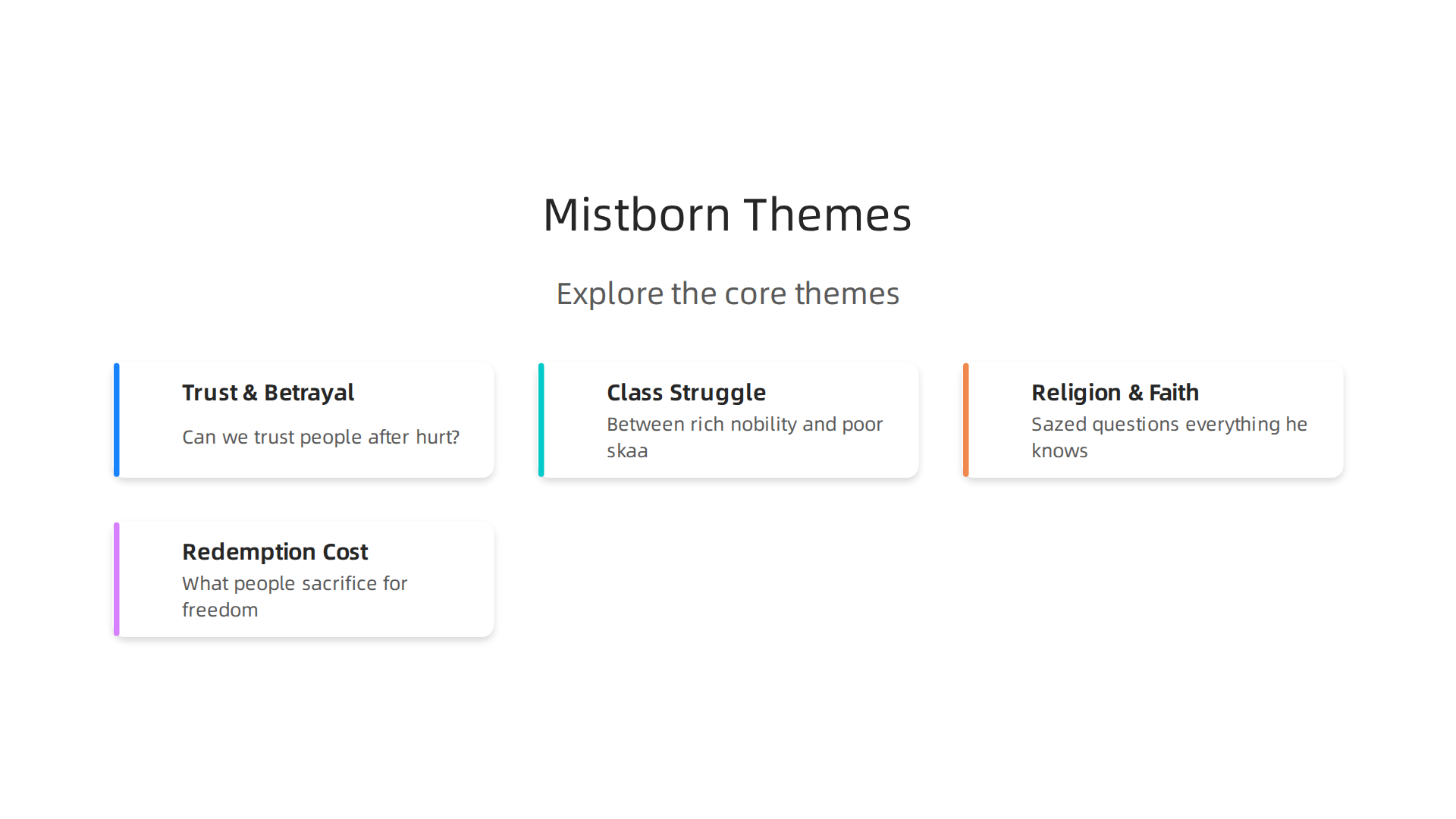
The books explore class struggle between the rich nobility and the poor skaa. They look at religion and faith through the eyes of Sazed, a keeper who questions everything he knows. They also dig into redemption and the cost of power. The first story is built like a heist, but underneath it is a deep look at what people will sacrifice for freedom. A breakdown of Mistborn Themes shows how trust and betrayal drive almost every decision the characters make.
World-Building That Feels Real
The planet Scadrial is not just a backdrop. It is a character of its own. The world has a unique ecology, with ash constantly falling from the sky, strange mists that hide dangers, and plants and animals that adapted to survive. The history of the Lord Ruler’s empire, the politics of the noble houses, and the hidden secrets of the Terris people all feel organic. Everything connects. You learn small details early on that pay off in huge ways later. This kind of careful world-building is what separates good fantasy from great epic fantasy series. If you enjoy rich worlds like this, you might also enjoy our list of the 10 Best Fantasy Fiction Books of All Time for more immersive reads.
Why It Sticks With You
The emotional depth of the mistborn series is what makes it unforgettable. Characters make tough choices that are messy and morally gray. There are no easy heroes or clear villains. You watch Vin struggle with trust, Kelsier wrestle with his own dark side, and Wax deal with the weight of his past. These human moments make the story feel real even when people are burning metals and fighting gods. The series stays with you because it asks hard questions about who we are and what we believe. That is why it continues to be one of the most talked-about fantasy series today.
Where to Go After Mistborn: Related Series and Recommendations
If you have finished the mistborn series and are craving more, you have a whole universe of options. The best part is that you already know the kind of story you like: smart magic, gray characters, and a world that feels alive. So where should you turn next?
Stay in the Cosmere
The easiest path is to keep reading Brandon Sanderson’s interconnected universe. Many readers jump straight into The Stormlight Archive, which is his biggest epic fantasy series. It is a bigger commitment, but the payoff is huge. If you want something lighter first, pick up Warbreaker, a standalone novel that is free on Sanderson’s website. The stories are not directly connected, but you will spot fun references. Sanderson’s own site has a recommended reading order for new Cosmere readers that can help you decide.
Try Other Epic Fantasy Series
If you want to branch out into other worlds, there are plenty of epic fantasy series that hit similar notes. Scott Lynch’s The Lies of Locke Lamora is a heist story with clever characters and a dark city setting. For a longer journey, Robert Jordan’s The Wheel of Time is a classic that Sanderson himself helped finish. You can find a handy Wheel of Time reading order guide to plan your dive. Or if you prefer something newer, try The Blood Over Bright Haven for explosive plot twists and moral complexity.
A Tonal Shift: Witty Sci-Fi Comedy
Maybe you want a break from the heavy stakes and constant ashfall. That is where The Ridiculous comes in. It is a comic sci-fi series with the same sense of clever discovery but a much lighter mood. Think quick humor, weird technology, and a world that feels just as inventive as Scadriel. It is a perfect palate cleanser for fantasy readers who want to laugh. You can check out The Ridiculous series to see if the tone matches your next mood.
No matter which direction you choose, the mistborn series has given you a great foundation. Now you just need to pick your next adventure.

Summary
This guide walks new and returning readers through Brandon Sanderson’s Mistborn series, explaining the world of Scadrial, the distinctive metal‑based magic systems, and the best reading order to avoid spoilers. It outlines Era 1 (the original trilogy) and Era 2 (the Wax and Wayne novels), describes how Mistborn connects to the wider Cosmere, and breaks down why the series is praised for its rules‑based magic and memorable characters. You’ll learn which book to start with, how the three magic systems interact, where the novella Secret History fits, and whether to follow publication or chronological order. The article also profiles key characters like Vin, Kelsier, and Wax, highlights central themes such as trust and sacrifice, and suggests what to read next within and beyond the Cosmere. By the end, readers will have a clear, practical roadmap for diving into Mistborn and deciding how to continue their fantasy reading journey.